Improvement Category

Do you support the rSPB?

Improvement, Uncategorized No Comments

I live in Cambridge. The city and its surrounding area is home to one of (if not) the biggest and most vibrant conservation communities in the world. The RSPB is part of it. However, that is not the rSPB I am thinking of here.

I work across sectors. Time and time again I see the attraction of structural change to leaders. The more senior they are, the more they are attracted it seems.

However, I largely agree with the Australian organisational commentator Peter Fuda that the search for the perfect structure is futile and that “With the right values and behaviours, almost any structure can work.”

If we see organisations as communities then getting the processes, as well as behaviours, right is also crucial. Actually these ideas can be implemented more quickly than structural solutions (which, to be clear, are important too). Simple rules to guide day to day choices and moment to moment decisions about the processes used and behaviours lived are enormously helpful. I wrote about this a few years ago using a rather unsavoury example.

rSPB?
Recommendations for results from Structural, Process and Behavioural change. Think of something you are trying to achieve right now. Is your approach balanced – like a bird in flight?

Tags:

Expectation vs cynicism management in NPO

Improvement, Noble Purpose No Comments

In my discussions and presentations about Noble Purpose Organisations, I am keen to be a positive help. I am happy to engage with cynicism but don’t want to fan its flames.

Why engage with cynicism? As I have outlined here I do see cynicism as a buffer between stress and burnout in NPO. Scratch a cynic and you regularly find someone who’s heart has been broken or their high hopes dashed.

However, cynicism isn’t something that helps us live fulfilling lives or do great work.

This balance between helping and making things worse is a hard one.

Take this example, from a few years ago:

I see the group of new recruits through the window of the seminar room.
I join them for a morning.
They are new to the NHS from commerce.
Already managers there. Wanting to be leaders here.
Buoyed up with excitement at the chance to make a difference.
Now weeks later, their hearts are heavy. They are pretty sad and down.
At the politics (small p), rudeness, disinterest, unkindness…
I explain my ideas on NPO. They are not alone.
That seemed to help.
But now to find the next step.
I hope I left them inspired to act.

How did I do?
Maybe the score was
Positive helping 1 : Fanning the flames of cynicism 1

Tags:

NPO? Here we go…On the way, to the Triple A?

Improvement, Noble Purpose No Comments

Today I start a series of blogs on Noble Purpose Organisations.

The world of worthy work can be perplexing. They can be hard teams to lead, not easy places to work in. And yet…they can provide a way to achieve some of the most beneficial gains for humanity and the planet.

In my pamphlet from earlier this year, building on my earlier post, I define the range of organisations (from small charities to the fairtrade arms of major multi-nationals) and describe how:

“the common feature in many Noble Purpose Organisations (NPOs) is what I call the ‘Noble Purpose Paradox’. In a nutshell, it is a pattern that not only bewilders and frustrates long serving managers but also comes as a shock to new recruits. Why is it that the more compelling the mission, the more tricky it can be to get the best collaborative behaviours and the necessary focused action? And how can some places that are trying to achieve the most crucial and needed changes to the world we live in can be so riven with petty politics and driven by individuals sometimes ruthlessly pursing their own agendas?”

Do you recognise that? In this case, this series is for you. If this doesn’t echo your experience, please do challenge me!

I don’t want to come over too negative or bleak: my aim for this series is to be an encouragement. I will raise some challenging issues – but mainly as questions for further research and reflection. Overall, I want to provide ideas for action. Ideas to inspire…

So, getting going – his is my version of the Triple A rating.

A quick test…do you think your team or organisation
1) Has clearly Aligned staff?
2) With an embodiment of the Attitudes that you are promoting more widely (eg care, learning)?
3) And an Awareness and acceptance that not everyone has to see things the same way?

I am going to guess that 1 and 2 are hard.

However, for me the key place to start is at 3: exploring how people see things differently. Asking what others see – not advocating a point of view. My recent business briefing provides some pointers.

Once that sort of curiosity is in place it is possible to pursue a balance that is at the heart of positive working experiences and outcomes in NPO. I believe truly excellent results come when staff have the autonomy to follow their passion and use their initiative – whilst working within the systems of accountability to guide that energy. That balance brings us back to the leadership work needed to ensure aligned action (1) and appropriate attitudes (2).

[To be continued!]

Tags:

Lessons for the NHS…from Vincent Van Gogh

Improvement, Organisations No Comments

A friend recently went to visit the Van Gogh museum in Amsterdam. She was hugely impressed by the work – and one thing in particular stood out. From the tour, she learnt how derivative Vincent Van Gogh’s work was, in some ways. His oeuvre wasn’t totally unique. He used and combined what he learnt over a short period of time in Paris.

He copied others, for example
– Delacroix in his use of a colour wheel for bold, almost clashing, contrasts.
– Romanticism for its use of texture
– Impressionism and pointillism for pixilation in composition

He added this to his use of a wooden perspective frame to help him get a sense of aspect that alluded him naturally, like the early masters.

He used others’ ideas and strengths – and yet he combined them into something unique and powerful.

He wasn’t afraid to ‘steal with pride’.

The English NHS has been in the news this week. As I have written before the desire to copy other people’s good ideas is at the heart of improvement. Those to learn from might be on the next shift or the next ward or the adjacent profession or the younger recruit or the older team member. Or maybe from far away: this piece  outlines some of the many things that could be creatively pursued in a ‘pick and mix’ – learn from elsewhere – fashion.

Tags:

Perspective management self assessment

Improvement, Personal productivity No Comments

Further to the recent blog series on ‘perspective management’, please see my simple 4 question self-assessment here:  http://www.idenk.co.uk/business_briefing/2014-sept.shtml

So, are you…?

Tags:

Innnovation…in the kitchen: on the importantance (or not) of rules

Improvement No Comments

My nephew is now in his late 20s. Ten years ago, for his 18th birthday, we went to the top restaurant in Cambridge. After the meal we had a tour behind the scenes. Like Heston, there were lots of gadgets and interesting ways to cook: water baths, foam makers…

My nephew went on to work in a top Cambridge college kitchen, then went to university in his mid-twenties and now is a successful estate agent in London.

Like him I have been on a journey – though mine is still a culinary one.

It started out with Keith Floyd. I read an interview with him years ago where he outlined his principles for great cooking: buy the best ingredients you can find, cook them as simply as you can and serve with the nicest wine you can afford. Those rules have served me well for many years.

However, my latest application of those now involves the freezer! This is not the more usual trick of storing small bits of wine or even crumbled cheese – ready to use in dishes. You read about those a lot.

My discovery? Cooking from Frozen. Very little on line.  Am I the only one?

This is not about ready meals into the microwave for a minute longer than they would get starting at fridge temperature. Rather, this approach begins with home cooked food straight from the freezer to a medium-hot oven…

This might be with a dish you have already prepared:
1) A fruit crumble (with my gluten free topping of butter in chickpea and rice flour, but that is another story)
2) Lentil bake or nut roast
3) Chilli skins – left over chicken or fish skins in chilli sauce
4) Gratins
5) etc

The beauty of this method is twin pleasures of soft and crunchy; tender and browned (see photo series here).

However, this style of cooking really comes into its own if you are a meat eater.

Whilst in our home Beer Can Chicken is the total favourite (have a search on google if you don’t know what that is…), the frozen to oven approach is great for individual cuts: such as rib of beef and other roasts; duck and chicken breasts; rack of lamb and kebabs. By the time the meat in the middle is cooked the outside is nicely coloured and textured.

It works a treat when cooking up a combination of potatoes, onions and (frozen) sausages stirred regularly to spread the juices around.

And in casseroles (from coq au vin to one involving chicken, raw onions, parmesan, pepper and cream) it is brilliant – never again the trade-off between tough chicken or hard vegetables.

[By the way, alongside this you can cook what I call ‘potatoes done two ways’: half roast/half baked…both at the same time. Cut in half, put a bit of fat and salt on the cut side, place on tray, cook – don’t move the potatoes on the tray until they are ready and you serve them carefully to keep the crisp edge intact.]

Now, if this was a regular food web site I would say do use a thermometer when cooking from frozen, which is probably a good idea.  However, on the whole, by sight and touch I can tell if cooked (from a catering trick my nephew taught me…I am happy to share more).

The lesson? Do you enjoy following recipes or applying principles or breaking the rules? In the kitchen, in business, in life?

Tags:

WITOS: The lens (and examples) of perspective

Improvement No Comments

This is the fourth blog in my series on perspectives (well actually the fifth if you include this one from a couple of weeks ago).

Are you fascinated by different perspectives?

Do you share my joy in trying to see things differently?

Like me are you keen to try to get less frustrated by a different angle or point of view?

Discipline is important. WITOS is a helpful tool. It helps us see both sides

What Is The Other Side…

Are these following examples useful provocations and lessons? Let’s have a look through the lens of perspective

Whistle-blowers? Trouble-makers protecting their interests or self-sacrificial saints? Discuss?

The Taliban? Our foe or a fiction.

Are you with the pious cyclist? Ringing their bell, assuming right of way, making a woman and cyclist coming the other way retreat and retract. Or the woman on her bike virtuously manoeuvring to the right hand side of a one way street to force an oncoming cyclist coming the other (wrong) way to mound the pavement.

Looking at the excellent, perspective provoking mini exhibition on German WW1 medals at The British Museum, I was reminded of the British Library show’ on propaganda. Both demand a consideration of other points of view.

Like me do you delight in the surprising success of the Cambridge guided bus way despite the complaints? Every time is see a packed vehicle it reminds me how it has questioned my assumptions from 5 years ago.

Do you like to play ‘The Devils Advocate’? In a way WITOS invites that. The play and film The History Boys revolves around the training the lads get to think about unusual perspectives. Have a look online for quotes from the story – some great inspiration there.

Do you see ingredients past their best as a waste or inpsiration for a new dish. Some well overripe tomatoes and a soft rind cheese beyond its best helped make a brilliant potato gratin last weekend.

Is the middle or the top of The Shard the best view? Is higher better – as the sense of perspective from lower down fades…Try the test on the Eiffel Tower – or The Petronas Tower vs. the Traders hotel bar looking onto the view.

WITOS on a plane…reading as many papers from around the world as I can fit into one flight…and getting surprised, for example in The Daily Mail.

Was the latter work of Matisse the mess of an old man or infirmity inspired innovation? what do you think of The Cut Outs? Personally, I like the emphasis on prototyping – and the way it forced the attempting of something new.

And in gardening, are you 100% confident on what is a weed or plant?

And finally…Do you like the original or later version of Both Sides Now, by Joni Mitchell!?

Both Sides Now – WITOS – enjoy the journey.

Tags:

The Power of Perspective

Improvement No Comments

Do you share my perspective on perspectives (or are you at least a little bit curious about it)? Are you keen to develop as a ‘perspective manager’?

If so, read on. (If not, please let me know – I am interested in your viewpoint.)

So, a curiosity about missing perspectives is at the heart of business success – in avoiding group think, reducing the risk of premature formulation about a plan of action and in helping communications that connects with the interests of the target audience. Fundamentally this helps achieve better decisions and more likely action.

However, curiosity is not necessarily the natural order in our organisations – see this observation on the NHS, and this piece arguing for a change . Many of us tend to advocate for ideas and ways forward that are close to our heart, and possibly not fully thought through. Advocacy (not inquiry) dominates our business life.

Uncertainty and awareness of the limitations in our understanding are seen as signs of weakness, witness the case of poor old Donald, whose google name check gets right to the well known ‘unknowns’ many times on page 1, despite his other claims to fame (or infamy).

Spending time in the early parts of the decision making diamond is important – clarifying questions, exploring opinions…. The art of good judgement in getting a good balance between divergence and convergence is a (possibly THE) key skill for a leader.

A few things are necessary in trying to improve this situation of low perception about different perspectives:

Firstly there needs to be some safety to explore difference of perspective – this will lead to conflict, which we know is frequently feared in organisations. Of course, a team or leader may not be trustworthy enough for the risk of honesty! Tread and handle with care…and lead the way whenever you can (valuing the challenge, the whistle-blower, the critic).

Secondly, it is important to keep moving and not get stuck over analysing difference perceptions – taking decisions, reviewing action, thinking of the next step, acting again – see this recent blog on cycles.

Thirdly, when you are certain, think like a scientist – identify your assumptions and look for evidence to disprove them! Hard work, but valuable. Popper  would be proud. Actually, so would the artist – who is keen to play with your (and maybe their) perspective of life or an object.

How can you apply this? Take responsibility to give it a go the next time you can. Maybe apply the ideas this week to
1) An ongoing project that needs a rethink – what are none of us seeing? Is the activity addressing the need?
2) A person who irritates you – what is the interaction teaching you, about you?
3) A team meeting – how can you make it is safe space for productive conflict? Holding back on judgement, asking the hard questions?
4) A strategic conversation – what assumptions need to be identified, tested and jettisoned?
5) An important change – think, how is it likely to be received? What is the wisdom in any likely resistance?
6) A negotiation meeting – can you judge the wants, needs and likely veto points for those you will meet?

All the best in your journey as a perspective manager.

Tags:

The 2×2 Holy Grail

Feedback, Improvement, Reflect No Comments

There is one 2×2 matrix I am drawn to (and draw on) more than any other.

One that I have heard applied to government ministers, heart surgeons and sports players.

It is described in a number of ways, but it is really the same each time:
• Technical ability vrs living corporate values
• Aptitude vrs Attitude – see this tweet on it
• Skill vrs will
• Competence vrs likeability – see this  and the middle of this

When Secretary of State for health Alan Johnson was described by a few senior officials as a rare minister in the upper right box.

I have heard managers (and sports coaches) say they hire for aptitude and fire for attitude.

I have seen star performers sacked for refusing to budge out of the top left box.

It links to level 4 and 5 leadership in my values framework: www.idenk.com/values

Where are you? Where are your colleagues? Do you feedback on these things to each other? See the third type of feedback here.

The Holy Grail? Certainly the hardest.

Tags:

On the importance of Cycles

Improvement, Teams No Comments

As you might know, I am quite a fan of cycling – to the station, through town, to meetings…observing and thinking as I go.

However, this blog is NOT about bicycles.

Nor is it about the fad cycle, another sort that interest me (from management theories to technology to music to fashion).

It is a bit about the learning cycle, and the associated ideas…from Deming to Kolb.

It IS about the cycles that should be at the heart of organisational life. NOT the annual cycle, the three year cycle or even the long term economic cycle, despite the exhortations to think out of the short term performance box.

Rather it is the sort of cycle that helps individuals, teams and organisations get (and keep) on the front foot, and so move from:
– Struggling to good: recovering
– From good to great: improving
– From great to brilliant: inspiring

In my work helping people get onto the ‘front foot’ there is a pattern and rhythm that is worth paying attention to, whether it is in Corporate Boards, project teams and individual leaders. This cycle is the ‘gum’ needed to help when there is a big (t)ask – a big challenge, a significant goal, the need to get going. It helps groups of people deal with change – in team membership, team leadership, team context or team role.

It is seen in the month cycle used in individual coaching – it creates the reflection space for leaders to pause, review, think and plan…and so avoid the traps – in a framework I have Stolen With Pride for many years!

It is seen in the 4-8 week cycle in action learning sets.

It underpins the quarterly cycle used in the meeting architecture of productive teams.

It is at the heart of what helps a individual or group recover, improve or inspire.

It is in the pattern of the ‘90 day reviews’ that are very popular with some of my clients – as a way of focusing the work they are doing. In fact, I have just come off a call leading one with colleagues distributed across a continent. The after action review is a powerful part of this. The ‘quarter turn of the key’ helps crank insight into action. It keeps the Question:Breakthrough:Follow-through cycle going

I use it in my ‘team gymnasium’. [Gym? The ‘technology’ and exercises I use in the team gymnasium is a blend integrated into 6-9 months of activities for individual team members (monthly) and the team together (quarterly).] The combination of assessment, pre-reading, talks, sessions and action planning helps to stimulate and maintain momentum. It encourages growth and helath.

The framework of mine I get asked for most often, and the tweet of mine that has been retweeted or favourited the most, is the same one. It is about this cycle. That model is a matrix that combines ‘abc’ and ‘5-30-90’. It is a key part of the Team Gymnasium. It can be used in a rolling manner in line leadership and executive coaching.

So what are the key elements of this ‘cycle’ I have alluded to? It is marked by:
1) Its pro-activity: the choice to keep moving (and meeting) to maintain and build momentum – no matter how hard.
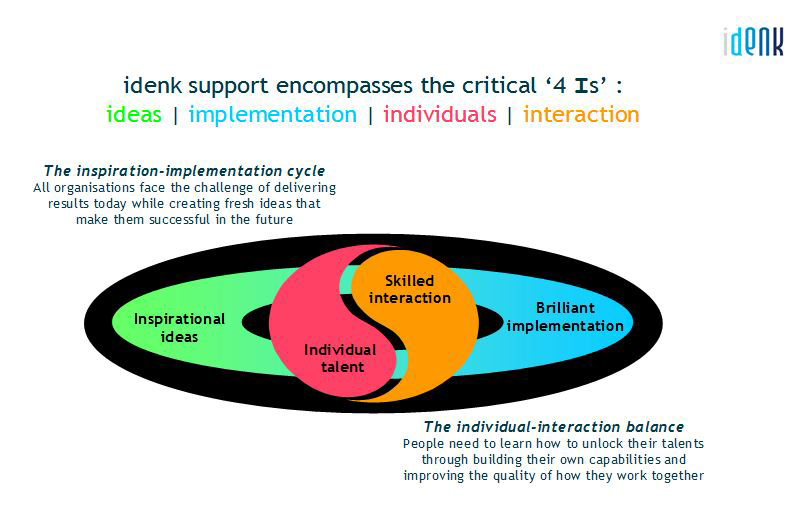
2) The underpinning curiosity about improvement, impact, individual views (not quite the 4i model – nearly).
3) The way it becomes the forum for reflection and reflective practice (btw, I argue this is most essential in Noble Purpose Organisations, due to the perplexing patterns many encounter – more on that to come in an imminent blog, or email for my longer ‘Think Piece’).
4) The way it encourages individuals and teams.

Fundamentally, we are talking of cycles of experimentation…a feature that is at the root of human progress, from science to art; seen in history and in the world today.

So I specialise in ‘cycling’:

• The 1 month improvement approach in mentoring and coaching
• The 1-2 month learning set
• The 90 day reviews in change, improvement projects
• The ongoing Team Gymnasium – used in management development programmes too
• The annual business planning or strategy process
• The ad-hoc post project review.

Whatever you do (whether you are a line manager or an executive leader), are you a ‘cycle coach’ too?


Tags:

Phil's Blog

Sign up for Phil’s regular blog.

Email: phil.hadridge@idenk.com